Does Hair Actually Grow Faster in Summer?
Quick Answer: Yes, modestly. Studies have found a seasonal pattern where a higher proportion of hair follicles are in the active growing phase during summer, with the lowest proportion in autumn. The effect on actual growth rate is small - measured in fractions of a millimetre per month - and nothing like the difference people report noticing. What you actually notice in summer is faster-growing body hair, quicker-appearing roots on coloured hair, and more visible shedding a few months later.
Your hair does grow slightly faster in summer.
Not as much faster as it feels, and the more interesting effect arrives in September.

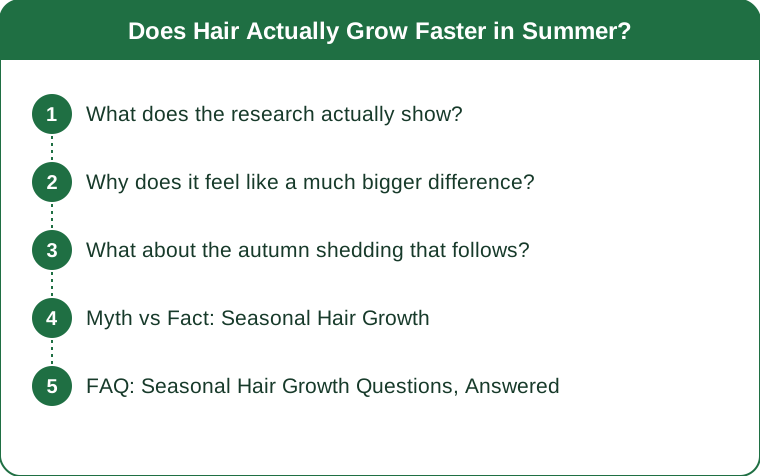
What does the research actually show?
A seasonal rhythm in how many follicles are growing, not a large change in how fast they grow.
Hair grows in a cycle with three phases. Anagen is the active growing phase, lasting two to six years for scalp hair. Catagen is a short transitional phase. Telogen is a resting phase of around three months, at the end of which the hair sheds.
At any given moment roughly 85 to 90% of scalp follicles are in anagen and 10 to 15% in telogen. The seasonal effect is a shift in that ratio.
Studies tracking this across a year have found the proportion of follicles in telogen peaks in late summer and early autumn, with the highest proportion in anagen occurring earlier in the year. The practical result is a seasonal shedding pattern rather than a dramatic growth-rate change.
Average scalp hair growth is around 1cm to 1.25cm per month. The seasonal variation on that figure is small - it does not double, and the difference over a whole summer is on the order of a few millimetres.
Proposed mechanisms, none conclusively established:
- Daylight exposure and melatonin. Melatonin receptors are present in hair follicles, and light exposure changes melatonin patterns
- Temperature and circulation. Warmer conditions increase peripheral blood flow, which may support follicular activity
- Vitamin D. Vitamin D receptors play a role in the hair cycle, and levels are higher in summer
- An evolutionary hangover. Many mammals have pronounced seasonal coats, and human seasonality may be a faint remnant
The honest position: the pattern is reasonably well documented and the mechanism is not settled, and the magnitude is smaller than the internet suggests.
Why does it feel like a much bigger difference?
Because several other things genuinely change, and they are more visible than growth rate.
Body hair does grow noticeably faster in warmer conditions, and it is far more visible than scalp growth because it is short. A 20% faster growth rate on a hair that is 5mm long is obvious within days; the same rate on hair that is 40cm long is invisible.
Roots on coloured hair appear to arrive faster, partly from growth and substantially because sun exposure lightens the lengths while the roots stay unchanged, which increases the contrast at the regrowth line.
Hair texture changes with humidity, which people frequently interpret as a change in the hair itself. Higher humidity means more water absorbed into the shaft, which means more swelling, more wave and more volume.
Nails do the same thing, and people often notice both together and conclude something systemic is happening. Nail growth does have a documented seasonal pattern, which reinforces the impression.
And there are genuine behavioural changes in summer:
- More frequent washing, which changes texture and how hair looks
- Less heat styling, which reduces breakage - and less breakage means hair retains length better
- More time with hair up, which reduces mechanical damage on the lengths
- Better vitamin D status and often more varied fresh food
Length retention is the underrated factor here. Hair that breaks less appears to be growing faster even at an identical growth rate, because you are keeping more of what grows. For many people the summer effect is largely a reduction in heat styling.
Which points at something useful: if hair seems to grow better in summer, the controllable part is probably the styling habits rather than the season.

What about the autumn shedding that follows?
That is the more noticeable half of the same seasonal cycle, and it is normal.
Telogen lasts around three months, and hairs entering it in late summer shed in autumn. Which is why September through November is when people notice a marked increase in hair coming out in the shower and the brush.
Studies have consistently found this pattern, and it is one of the more robust findings in seasonal hair research. The increase is real and temporary.
What is normal:
- Losing 50 to 100 hairs a day is typical baseline
- A seasonal increase above that in autumn is expected, and can feel dramatic
- It resolves within a few weeks to a couple of months
- It affects the whole scalp evenly rather than in patches
What is not seasonal shedding:
- Shedding that continues beyond a couple of months
- Visible thinning at the parting or a widening part line
- Patchy loss or defined bald spots
- Shedding accompanied by scalp pain, itching or visible scaling
- A dramatic increase with no seasonal timing - this often points to telogen effluvium from illness, stress, a nutritional deficiency, childbirth or a medication change, typically two to three months after the trigger
Any of those is worth seeing a doctor or dermatologist about, particularly since many causes of the second list are treatable when identified early.
What actually helps during a seasonal shed:
- Nothing dramatic. The shed hairs have already completed their cycle and no product brings them back
- Be gentle - reduce tight styles and aggressive brushing, since breakage on top of shedding compounds the appearance
- Keep protein and iron intake adequate, both of which genuinely matter for hair
- Wait it out. Follicles that shed in autumn re-enter anagen and regrow
And a note on panic-buying supplements in October: the shed you are seeing was determined three months earlier. Anything you start now affects hair three months from now, which is worth knowing before spending money in response to a normal seasonal pattern.
Myth vs Fact: Seasonal Hair Growth
Myth: Hair grows dramatically faster in summer. Fact: The seasonal effect is real and small - a shift in the proportion of follicles actively growing, not a large change in growth rate. Average growth stays around 1cm to 1.25cm per month year-round.
Myth: Autumn shedding means something is wrong. Fact: It is the most robustly documented part of the seasonal cycle. Hairs entering the resting phase in late summer shed roughly three months later. It is even across the scalp and resolves within weeks to a couple of months.
Myth: Trimming hair in summer makes it grow faster. Fact: Growth happens at the follicle, and the ends have no influence on it. Trimming removes split ends, which prevents breakage travelling up the shaft - so you retain more length, which looks like faster growth and is not.
Myth: Sun exposure damages hair growth. Fact: UV damages the hair shaft - the protein structure and the colour - not the follicle’s growth activity. Sun-damaged hair breaks more, which reduces length retention. The growing part is protected by your scalp.
Myth: Supplements will stop an autumn shed. Fact: The hairs shedding now entered their resting phase three months ago. Nothing started today changes that. Supplements affect hair that grows in the future, and only genuinely help if you were deficient in something.
Myth: Hair feels thicker in summer, so it is growing better. Fact: Humidity swells the hair shaft, adding volume and wave. It is the same hair holding more water. This is one of the biggest reasons the seasonal effect feels larger than it measurably is.
FAQ: Seasonal Hair Growth Questions, Answered
How much faster does hair actually grow in summer?
Only slightly. The documented effect is a shift in how many follicles are in the active growing phase, not a large change in rate. Average growth remains around 1cm to 1.25cm per month, and the seasonal difference over a whole summer is a few millimetres.
Why do I shed so much more in autumn?
Because the resting phase lasts around three months, so follicles that entered it in late summer shed in autumn. It is the most consistently documented part of the seasonal pattern and it resolves within weeks to a couple of months.
When is shedding not normal?
When it continues beyond a couple of months, comes with visible thinning at the parting, occurs in patches, or is accompanied by scalp pain, itching or scaling. Any of those is worth seeing a doctor about rather than waiting out.
Does sun damage affect hair growth?
It damages the shaft rather than the follicle - the protein structure and colour. The growing part is beneath the scalp and protected. The practical cost is more breakage, which reduces how much length you retain even at an unchanged growth rate.
Why does my body hair seem to grow much faster than my scalp hair?
Partly because it does grow somewhat faster in warm conditions, and largely because it is short. A few millimetres of growth is immediately obvious on a 5mm hair and invisible on a 40cm one.
Should I take supplements for an autumn shed?
Only if you are actually deficient in something - iron and vitamin D are worth checking with a blood test. Hairs shedding now entered their resting phase three months ago, so nothing started today changes what you are seeing.
TL;DR:
- The seasonal pattern is real: more follicles in the active phase in summer, more resting by late summer
- The growth rate change is small - average stays around 1cm to 1.25cm per month
- Autumn shedding three months later is the more noticeable half of the same cycle, and it is normal
- Body hair growth is more visible because the hairs are short, not because it is much faster
- Humidity swells the shaft, adding volume - people read that as thicker, faster-growing hair
- Less heat styling in summer means less breakage and better length retention, which looks like growth
- Patchy loss, a widening part, or shedding past a couple of months needs a doctor, not patience
The controllable part was never the season. It was the styling.
Keep Reading
This article is for general informational purposes only and is not medical advice. Always consult a qualified health professional for guidance specific to you.