Does Wearing a Hat Cause Hair Loss? What Actually Happens
Quick Answer: A normally fitted hat does not cause hair loss. Follicles get their oxygen and nutrients from blood supply beneath the scalp, not from air above it, so covering your head does not starve them. But three real problems exist: very tight hats worn daily can contribute to traction alopecia at the hairline, dirty hats plus a sweaty scalp can trigger folliculitis or worsen seborrheic dermatitis, and hats hide thinning that is already progressing - which is why people so often connect the two.
The myth persists because the correlation is real and the causation runs the other way: people who are losing hair wear more hats.

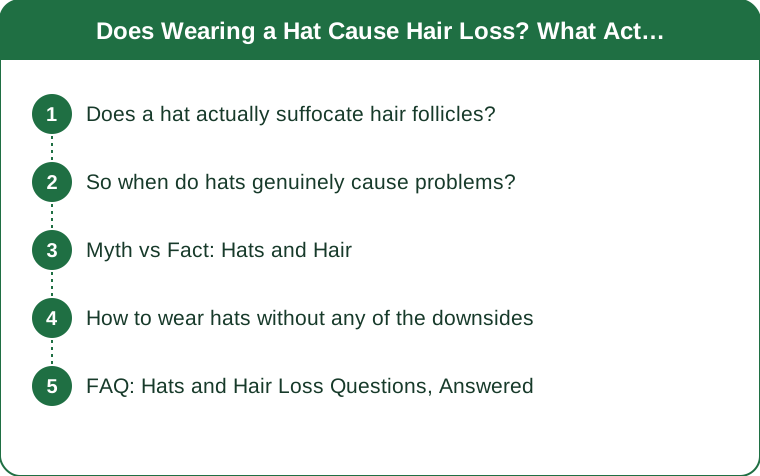
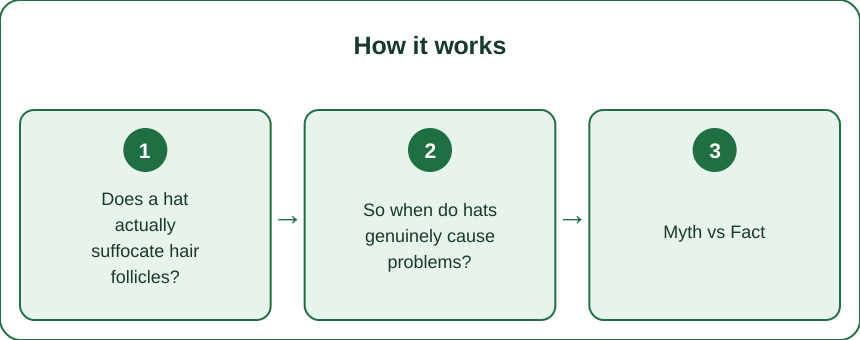
Does a hat actually suffocate hair follicles?
No, and the mechanism people imagine does not exist.
Follicles are nourished from below. The dermal papilla at the base of each follicle is fed by capillaries in the scalp. Oxygen and nutrients arrive through blood, not through the air touching the hair shaft. The visible hair itself is dead keratin and requires nothing from its environment.
Scalp skin does exchange some gas with the air, but not in a way that a hat meaningfully restricts, and certainly not enough to affect a structure fed by the circulatory system.
The studies do not support the claim. The most frequently cited evidence is a study of identical twins where hat wearing was not associated with the pattern of loss; frontal hairline recession in that work was associated with other factors entirely.
Male and female pattern hair loss is driven by genetics and hormones - specifically follicle sensitivity to DHT - operating on a timeline that has nothing to do with headwear.
Where the myth comes from is worth understanding: hat use rises as hair thins, because a hat is the easiest way to cover it. Observers see hats and thinning together and reverse the arrow. The hats are a response, not a cause.
So when do hats genuinely cause problems?
Three specific situations, all of which are avoidable.
Traction alopecia from consistently tight headwear. This is the real one. Sustained tension on hair follicles - from tight braids, tight ponytails, extensions, or a genuinely tight hat band worn for many hours daily over years - can cause gradual follicle damage at the point of tension. The hairline and temples are where it shows. It requires real, sustained tightness, not ordinary wear.
Folliculitis from trapped sweat and bacteria. A hat worn during training, never washed, and put back on the next day is a warm damp surface pressed against a sweaty scalp. That can produce inflamed follicles - small tender bumps - and repeated inflammation is not good for hair. This is a hygiene problem with an easy fix.
Aggravating seborrheic dermatitis. If you are prone to a flaky, itchy scalp, the warm humid environment under a hat can worsen it. Inflammation and scratching cause breakage, and severe chronic inflammation is not helpful for growth.
And mechanical breakage at the band line. Hair repeatedly compressed and rubbed at the same point - especially when damp - breaks there. This is breakage, not loss: the follicle is fine, the strand snapped. It looks like thinning and behaves completely differently.
The distinction that matters: breakage produces short broken hairs of uneven length; true loss produces shedding from the root with a visible white bulb. Look at what is actually in your hairbrush before concluding anything.

Myth vs Fact: Hats and Hair
Myth: hats cut off circulation to the scalp. Fact: a hat that restricted blood flow would be painfully tight and would leave your scalp numb. Ordinary hats do not come close, and scalp circulation is not the limiting factor in pattern hair loss anyway.
Myth: hair needs to breathe. Fact: hair is dead keratin. The follicle is alive and fed by blood. The idea of hair breathing is a marketing concept, not a biological one.
Myth: wearing a hat while your hair is wet is fine. Fact: this is the genuinely bad version. Wet hair is weaker, and compressing it under a hat for hours adds friction to a fragile strand while extending the time it stays damp. If you do one thing differently, do not put a hat on wet hair.
Myth: beanies are worse than caps. Fact: the fit matters, not the style. A loose beanie is gentler than a tight cap. What causes trouble is any band that leaves a deep mark or a headache.
Myth: hats cause receding hairlines in men. Fact: male pattern recession follows a genetic pattern that is remarkably consistent across cultures with completely different headwear habits. Traction alopecia, by contrast, follows the line of the tension - which is a different and recognizable pattern.
Myth: if I stop wearing hats my hair will grow back. Fact: only if the problem was traction or breakage, and only if caught before follicles are permanently scarred. Pattern loss will continue regardless.
How to wear hats without any of the downsides
Six habits, none of them demanding.
Fit loosely enough to leave no deep mark. If removing your hat reveals a pressure line that takes minutes to fade, or gives you a headache, it is too tight. You should be able to slide a finger under the band comfortably.
Wash hats regularly. Every one to two weeks for daily wear; after every use for training hats. Most caps handle a gentle cold wash and air dry. The sweat, oil, and bacteria that build up are the actual cause of hat-related scalp problems.
Never on wet hair. Dry to at least 90% first. This single rule prevents most hat-related breakage.
Vary the position. Wearing the same hat at the exact same tension in the same spot every day concentrates tension in one line. Rotating between a cap and a looser beanie, or simply shifting where it sits, spreads the load.
Take it off periodically. Ten seconds every couple of hours to let the scalp cool and dry - especially in a heated indoor environment - reduces the humidity that scalp problems thrive on.
And notice what changes seasonally. Autumn brings both more hat use and the tail end of seasonal shedding, which peaks for many people in late summer and early autumn. Those two overlapping is exactly how the myth gets renewed every year - the shedding would have happened anyway.
FAQ: Hats and Hair Loss Questions, Answered
Can wearing a hat every day thin my hair?
Not through covering it. It can if the hat is tight enough to create sustained tension at the hairline, or if it is never washed and your scalp becomes inflamed. A clean, comfortably fitted hat worn daily is not a problem.
Why does my hair look thinner when I take my hat off?
Compression flattens hair against the scalp, which makes the scalp more visible. It looks like thinning and is not. If it still looks thinner after your hair recovers its volume, that is worth investigating separately.
Do helmets cause hair loss?
Same answer as hats, with more friction. Cycling and motorcycle helmets can cause breakage at pressure points and sweat-related scalp irritation, so a moisture-wicking liner and washing the padding both help.
I am shedding more in autumn - is my hat to blame?
Almost certainly not. Seasonal shedding peaks for many people in late summer and early autumn and typically resolves within a couple of months. Shedding that continues beyond three months, or comes with visible scalp or patchy loss, is worth a professional opinion.
This is general information, not medical advice. Sudden, patchy, or persistent hair loss should be assessed by a doctor or dermatologist.
TL;DR:
- Hats do not suffocate follicles - hair is fed by blood from below, not air from above.
- Real risks are traction from genuinely tight hats, folliculitis from dirty ones, and breakage from wearing hats on wet hair.
- Fit loosely enough to leave no mark, wash hats regularly, and never put one on damp hair.
- Autumn shedding overlapping with more hat wearing is why the myth gets renewed every year.
If you are worried about thinning, the hat is the least productive place to look. Check whether what you are seeing is breakage or shedding from the root, note whether it has lasted more than three months, and take that information to a professional rather than giving up a hat that was never the problem.
Keep Reading
This article is for general informational purposes only and is not medical advice. Always consult a qualified health professional for guidance specific to you.