Your Hair After Summer: What Actually Needs Repairing and What Doesn't
Quick Answer: Summer damages hair in three distinct ways — UV degrades the protein in the cuticle, chlorine and salt strip lipids and dry the strand, and heat plus mechanical friction causes physical breakage. Only the second is genuinely reversible. Protein treatments help structural damage, moisture treatments help lipid loss, and nothing rebuilds a split end. The most useful thing you can do in September is a two-week alternating protein-and-moisture routine, then a trim.
Your hair feels like straw at the ends and looks fine at the roots, and every product on the shelf claims to fix it.
Most of them address one of the three problems. The trick is knowing which one you actually have, because using the wrong one makes hair worse in a very specific and recognizable way.

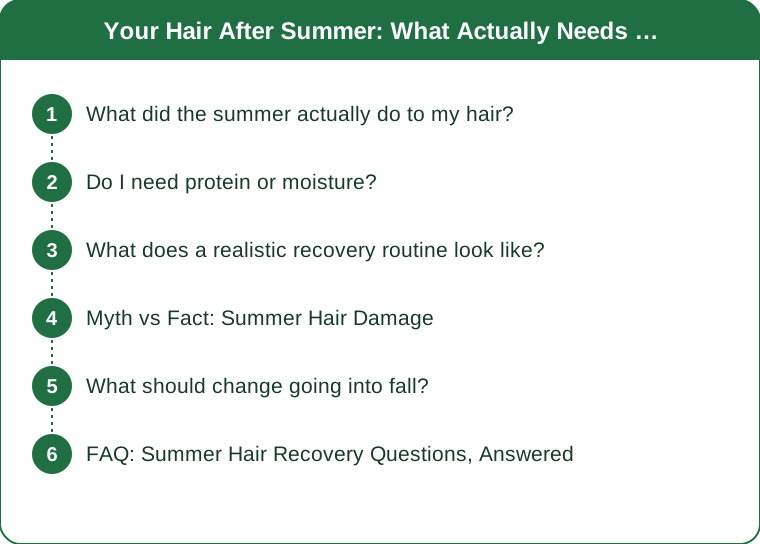
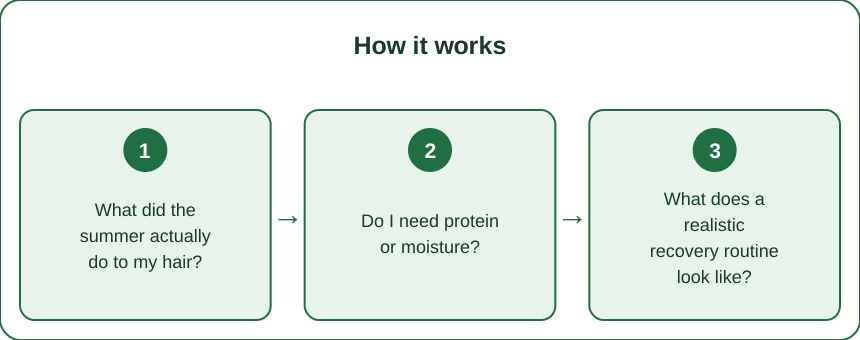
What did the summer actually do to my hair?
Three separate mechanisms, and they leave different signatures.
UV degrades keratin and destroys pigment. Sunlight breaks disulfide bonds in the hair’s protein structure and oxidizes melanin. The signature is lightened, brassy ends and a rough, porous texture — hair that soaks up water instantly and takes forever to dry.
Chlorine and salt strip the lipid layer. The 18-MEA lipid coating on healthy hair is what makes it repel water and feel smooth. Chlorine oxidizes it away; salt draws water out osmotically. The signature is dullness, tangling, and a squeaky, grabby feel when wet.
Heat and friction break the strand physically. Blow-drying, hot tools, sun-bleached hair rubbing under a hat or against a backpack strap. The signature is split ends, mid-shaft breakage, and short flyaway hairs at the crown that are actually broken strands, not new growth.
Which one you have determines what works. Protein treatments help the first. Moisture and lipid treatments help the second. Nothing repairs the third — scissors are the only treatment for a split end, and every product claiming otherwise is temporarily gluing it shut.
Most people have all three, in different proportions by length. Roots are usually fine. The last four inches are where all of it accumulated.
Do I need protein or moisture?
This is the single most useful diagnostic question in hair care, and there’s a two-minute test for it.
The stretch test. Take one clean, wet strand and pull it gently. If it stretches a long way and doesn’t return — mushy, gummy, elastic — you need protein. If it snaps almost immediately with no stretch — brittle, crunchy — you need moisture.
Protein overload is real and it’s common among people who’ve been panic-treating damaged hair. The symptoms — stiffness, straw texture, breakage — look identical to damage, so people apply more protein and make it worse. If you’ve done three protein masks in two weeks and it feels worse, stop.
Moisture overload also exists, and looks like limp, over-soft, undefined hair that never holds a style.
The healthy state is a balance, and summer usually knocks out both — protein via UV, moisture via chlorine and salt. That’s why alternating works better than picking one.
Retest every two weeks. The right answer in early September is often not the right answer by October.
What does a realistic recovery routine look like?
Two weeks of alternating treatments, then a trim, then back to normal. Not a permanent overhaul.
Week one, day one: a clarifying wash. Chlorine, salt, mineral buildup from pool and ocean water, and layered product all sit on the strand and block everything else from working. This is the step people skip and it’s why nothing else lands. Once — not weekly.
Day two: a protein treatment. A hydrolyzed protein mask, 15 to 20 minutes, rinsed thoroughly. Follow immediately with a conditioner. Protein without a moisturizing follow-up is the fastest route to that straw feeling.
Day five: a deep moisture mask. 20 to 30 minutes, ideally with gentle heat — a warm towel is enough. Focus on the last four inches; the roots don’t need it.
Day nine: repeat the protein step if the stretch test still says mushy. Otherwise repeat moisture.
Day fourteen: get the ends trimmed. Half an inch to an inch is usually enough and it does more for how your hair looks and behaves than any product in the two weeks preceding it. Damaged ends split progressively up the shaft — removing them stops that.
Then stop treating and start protecting. Recovery routines are temporary. The permanent change is a leave-in with heat protection and lower dryer heat.

Myth vs Fact: Summer Hair Damage
Myth: Hair repairs itself over time if you leave it alone. Fact: Hair is not living tissue. A damaged strand stays damaged until it’s cut off. What improves with time is the new growth coming in and the surface condition of existing hair — real, but not repair.
Myth: Bond-building treatments rebuild broken hair. Fact: They genuinely do reform some disulfide bonds, which is more than most products, and the chemistry is real. They don’t reconstruct a split or restore lost lipid, and they don’t replace a trim.
Myth: Rinsing with tap water after swimming is enough. Fact: It helps significantly and it isn’t complete. Chlorine binds to the hair shaft, and a rinse removes surface residue while leaving what’s bound. A chelating or clarifying shampoo once after a swim-heavy period does what rinsing can’t.
Myth: Trimming makes hair grow faster. Fact: Growth happens at the follicle and trimming doesn’t touch it. Trimming makes hair longer over time by preventing splits from traveling upward and forcing bigger cuts later — which is a different and more useful claim.
Myth: Air drying is always gentler than blow drying. Fact: Hair is at its most fragile when swollen with water. Prolonged wet time causes its own damage — hygral fatigue — so a low-heat blow dry after towel blotting can be gentler than four hours of air drying, especially for fine or high-porosity hair.
What should change going into fall?
Less protection from sun, more from heat and friction. The threat profile inverts.
Heat tool use goes up in autumn as the humidity that ruined every blowout disappears. A heat protectant becomes more important in October than it was in July, and most people’s routine goes the other direction.
Static and friction increase with dry indoor air. Wool coats, scarves, and hats create mechanical damage on already-weakened ends. A silk or satin scarf lining, or simply putting hair outside the collar, prevents a lot of it.
Seasonal shedding is normal and peaks in autumn for many people. Losing 100 to 150 hairs a day in September and October is within normal range and is not caused by your summer. It’s a follicle cycling pattern that resolves in six to eight weeks.
Scalp care matters more as heating starts. Indoor heating dries the scalp, and a dry, flaking scalp affects growth conditions. A weekly scalp massage and a gentler wash frequency both help.
Reduce washing frequency by one wash a week if you’ve been washing daily through summer. The lipid layer needs a chance to rebuild, and that’s the thing chlorine spent three months removing.
FAQ: Summer Hair Recovery Questions, Answered
How long does it take to see improvement?
Surface texture improves within one to two treatments. Real structural improvement takes the two-week protocol plus a trim. Anything past that is new growth, which appears at roughly half an inch per month.
Is a salon treatment worth it over a home mask?
For moderate damage, home masks plus a trim do most of the work. For heavily lightened or chemically processed hair that also got summer exposure, a professional bond treatment is genuinely better than the drugstore equivalent and worth the once-a-season cost.
Can I skip the trim if I’m growing my hair out?
You can, and the splits will travel up the shaft, meaning you’ll eventually cut more than you would have. A half-inch dusting every three months is the compromise most stylists recommend for people growing hair out.
Does hair sunscreen actually work?
UV filters in hair products do reduce protein degradation and color fading measurably. They wash out and need reapplication, so they’re most useful for a beach day rather than as a daily product.
My ends feel worse after a protein mask. What happened?
Protein overload — the classic sign. Skip protein for three weeks, do two moisture-focused deep conditions, and retest with the stretch test before reintroducing it.
TL;DR: Diagnose before you treat, because the wrong treatment makes summer damage worse.
- Three separate damages: UV protein loss, chlorine and salt lipid stripping, and physical breakage. Only the middle one fully reverses.
- Use the wet stretch test — mushy means protein, snappy means moisture. It takes two minutes and saves months.
- Clarify once first, or nothing else penetrates. Buildup from pool and ocean water blocks every treatment.
- Alternate protein and moisture across two weeks, then trim half an inch to an inch.
- Protein overload looks exactly like damage. If three masks made it worse, that’s your answer.
- Autumn inverts the threat — less sun, more heat tools, static, and collar friction.
Do the stretch test tonight before you buy anything. Half of the products people buy in September are treating a problem they don’t have.
Keep Reading
This article is for general informational purposes only and is not medical advice. Always consult a qualified health professional for guidance specific to you.