Are Your Hair Growth Vitamins Actually Being Absorbed? Here's How to Tell
Quick Answer: Fat-soluble hair vitamins (biotin, vitamin D, vitamin E) need to be taken with a meal containing some fat to absorb properly — taking them on an empty stomach can cut absorption significantly. If you’ve been taking supplements consistently for 3+ months with zero change and no meal timing, that’s the first thing to fix before assuming the product doesn’t work.
You’ve taken the same hair growth vitamin every day for months and your hair looks exactly the same. Before writing off the supplement entirely, there’s a simple variable most people never check.

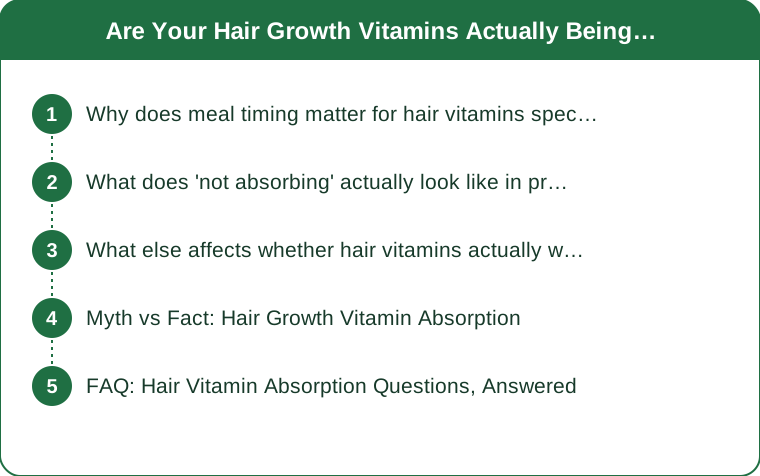
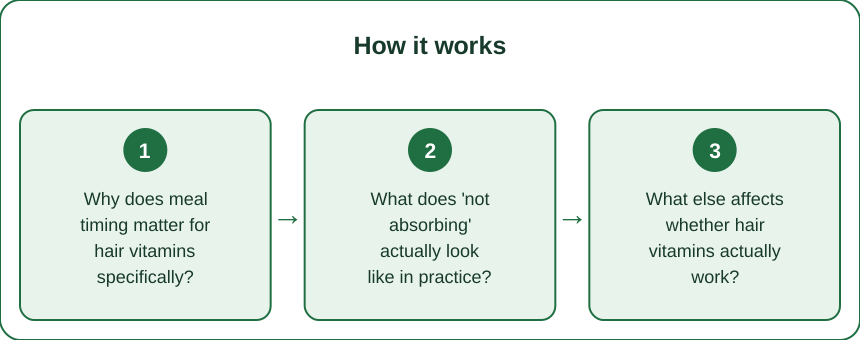
Why does meal timing matter for hair vitamins specifically?
Several key hair-growth nutrients — vitamin D, vitamin E, and to some extent biotin — are fat-soluble, meaning your body absorbs them far more efficiently when there’s dietary fat present in your digestive tract at the same time. Taking a fat-soluble vitamin with black coffee on an empty stomach can mean a meaningful fraction of it passes through unabsorbed.
Water-soluble vitamins (like most B-vitamins) absorb more consistently regardless of food, but even they benefit from being taken with food if it prevents you from skipping doses due to stomach upset.
What does ‘not absorbing’ actually look like in practice?
There’s no way to visually confirm absorption day-to-day, but the practical signal is months of perfectly consistent use with zero measurable change in shedding, texture, or new growth at the hairline. Hair growth is slow under the best circumstances (roughly half an inch a month), so give any regimen a real 4-6 month trial — but if you’re at that point with nothing to show, absorption or dosage is worth investigating before switching products again.

What else affects whether hair vitamins actually work?
- Underlying deficiency status: if you’re not actually deficient in a given nutrient, supplementing more of it rarely produces noticeable hair changes — it only helps close an existing gap
- Gut health: chronic digestive issues (IBS, unmanaged celiac disease) can reduce nutrient absorption broadly, hair vitamins included
- Consistency: sporadic use (a few times a week instead of daily) undermines results regardless of the product’s quality
- Timing with other supplements: high-dose calcium or iron taken simultaneously can compete for absorption with certain hair-relevant minerals like zinc
Myth vs Fact: Hair Growth Vitamin Absorption
Myth: More biotin means faster hair growth. Fact: Biotin deficiency is genuinely rare in people eating a varied diet — extra biotin beyond what your body needs doesn’t accelerate growth, it’s simply excreted. Megadosing isn’t more effective, just more expensive.
Myth: Gummy vitamins absorb the same as capsules. Fact: Absorption rates vary more by formulation and individual gut factors than by delivery format — neither is inherently superior, though gummies sometimes contain less active ingredient per serving than labels suggest.
Myth: If a supplement worked for a friend, it’ll work for you too. Fact: Response depends heavily on your individual deficiency status and underlying cause of hair thinning — a supplement addressing someone else’s iron deficiency won’t help hair loss caused by, say, thyroid issues or stress.
FAQ: Hair Vitamin Absorption Questions, Answered
Should I get bloodwork before starting hair vitamins?
Ideally yes — testing for iron, vitamin D, and thyroid function first tells you whether you’re actually deficient in what you’re about to supplement, rather than guessing.
How long should I try a supplement before deciding it’s not working?
At least 4-6 months, given hair’s slow growth cycle — shorter trials can’t distinguish ‘not absorbing’ from ‘not enough time yet.‘
Can taking hair vitamins with the wrong foods cancel them out?
Not cancel exactly, but very low-fat meals reduce fat-soluble vitamin absorption meaningfully — pairing with something like eggs or avocado rather than plain toast makes a measurable difference.
TL;DR:
- Fat-soluble hair vitamins absorb better with a meal containing some fat, not on an empty stomach
- Give any supplement 4-6 months before judging it, given hair’s slow growth cycle
- Vitamins only help if you’re actually deficient in that specific nutrient
- Consider bloodwork before starting to target the real gap instead of guessing
Keep Reading
This article is for general informational purposes only and is not medical advice. Always consult a qualified health professional for guidance specific to you.