Hair Shedding After a Restrictive Diet: Why It Happens Three Months Later
Quick Answer: Rapid or restrictive dieting can push a large number of hairs prematurely into the resting phase, and those hairs shed about two to four months later — which is why the shedding starts long after the diet. It is usually temporary and reverses once intake, protein and iron are restored, with regrowth visible in three to six months. Persistent shedding beyond six months, or shedding with other symptoms, warrants blood work and a clinician’s assessment.
The timing delay is the part that confuses everyone, and it is the strongest clue that this is what is happening.

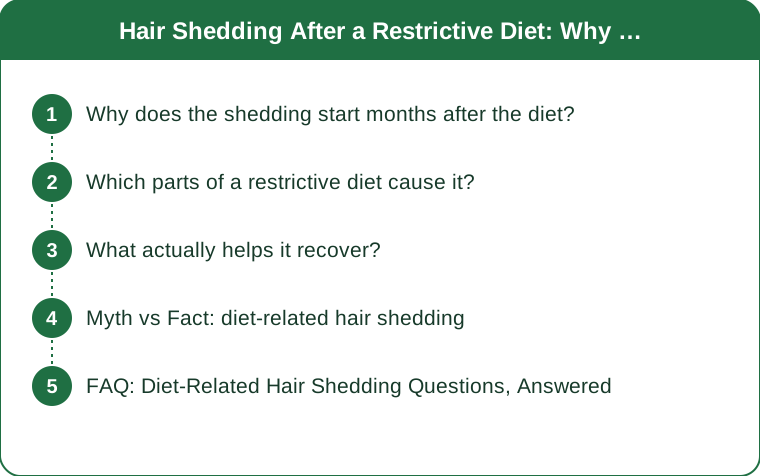
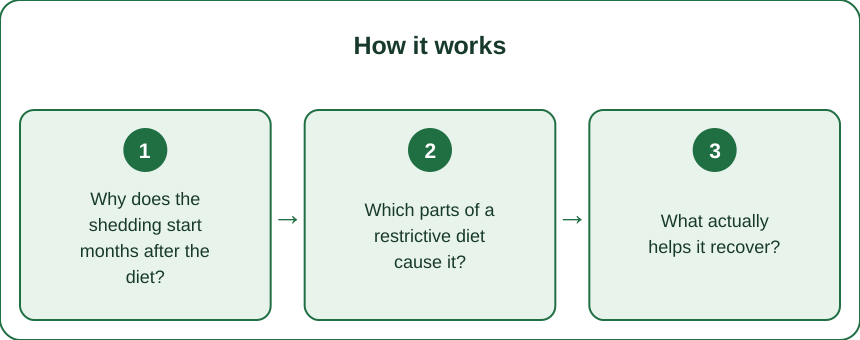
Why does the shedding start months after the diet?
Because of how the hair growth cycle is structured.
Each hair follicle cycles through three phases: anagen (active growth, lasting two to seven years), catagen (a short transitional phase), and telogen (resting, roughly three months, ending in shedding). At any given time, somewhere around 85 to 90 percent of your hair is in anagen.
What a stressor does. A significant physiological stress — rapid weight loss, severe caloric restriction, illness, surgery, childbirth — can push an unusually large proportion of anagen hairs into telogen at once. This is called telogen effluvium.
Why the delay. Those hairs do not fall out when they enter telogen. They sit there for approximately three months, still attached, and then release. So the shedding you see in August reflects a physiological event in May.
What it looks like: a diffuse increase in shedding across the whole scalp, not patches. More hair in the brush, in the drain, on the pillow. Often 200 to 300 hairs a day rather than the usual 50 to 100. The hairs come out with a small white bulb at the root, which is the sign of a completed telogen cycle rather than breakage.
What it is not: it does not produce bald patches, and it does not typically cause total hair loss. It causes diffuse thinning that most people notice as reduced ponytail thickness.
Which parts of a restrictive diet cause it?
Four separate deficits, often occurring together.
Caloric restriction itself. Hair is metabolically expensive and biologically non-essential. When energy intake drops substantially, the body deprioritizes hair growth. Very low calorie intakes sustained for weeks are a well-recognized trigger.
Protein inadequacy. Hair is largely keratin, a protein. Insufficient protein intake limits the raw material. Adequate intake for most active adults sits somewhere around 1.2 to 1.6 grams per kilogram of body weight, and restrictive diets frequently fall well short.
Iron and ferritin. This is the most common single deficiency associated with hair shedding, particularly in menstruating women. Serum ferritin — the storage measure — can be low while hemoglobin is still normal, so a standard anemia screen may not catch it. Many dermatologists look for ferritin comfortably above the bottom of the reference range when investigating shedding.
Zinc, vitamin D and B12. All associated with hair health, and all commonly low in restrictive or eliminative diets.
Rate matters more than amount. Gradual weight loss with adequate protein and micronutrients rarely triggers this. Rapid loss — particularly on very low calorie protocols or after bariatric surgery — commonly does.

What actually helps it recover?
Five things, in order of impact.
1. Restore adequate energy intake. This is the fix. Hair growth resumes when the body is no longer in a significant deficit. Continuing to restrict while taking supplements is working against yourself.
2. Hit protein consistently. Aim for roughly 1.2 to 1.6g per kilogram of body weight daily, spread across meals. This is the nutrient most directly connected to the raw material.
3. Get blood work rather than guessing. Ferritin, full blood count, vitamin D, B12, zinc and thyroid function. Thyroid dysfunction produces very similar shedding and is worth ruling out. Supplementing iron without knowing your levels is genuinely inadvisable — iron overload is harmful and iron supplements should follow a test, not precede one.
4. Be patient with the timeline. Once the trigger is removed, follicles re-enter anagen, but new hair grows roughly 1cm a month. Expect three to six months before visible regrowth and up to a year for full recovery of density. Short regrowth hairs around the hairline are the encouraging early sign.
5. Reduce mechanical stress in the meantime. Loose styles, gentle detangling from the ends, less heat, no tight ponytails. This does not treat the shedding but it prevents adding breakage on top of it.
What will not fix it: any topical product, any shampoo, and most hair supplements if your intake and labs are already adequate. This is a systemic issue and it resolves systemically. This is general information, not medical advice.
Myth vs Fact: diet-related hair shedding
Myth: If your hair is falling out, the diet damaged your follicles permanently.
Fact: Telogen effluvium is a cycling disruption, not follicle destruction. The follicles are intact and re-enter growth once the trigger resolves. This is one of the more reassuring facts about it.
Myth: A biotin supplement fixes it.
Fact: Biotin deficiency is rare in people eating a normal diet, and supplementing it when you are not deficient does not improve hair. It also interferes with several common lab assays, including thyroid and cardiac tests, which can produce misleading results — tell your clinician if you are taking it.
Myth: You should shampoo less to keep the hair you have.
Fact: Telogen hairs are going to shed whether you wash or not. Washing less just means more of them come out at once when you do, which looks alarming and changes nothing. Wash normally.
Myth: Losing 200 hairs a day means you will go bald.
Fact: Telogen effluvium is self-limiting. It typically runs its course over three to six months and stops. It causes diffuse thinning, not baldness, and it reverses.
Myth: It only happens with extreme diets.
Fact: It can follow a moderate but rapid loss, an eliminative diet that inadvertently cut a key nutrient, or a period of high stress combined with under-eating. The threshold is individual.
FAQ: Diet-Related Hair Shedding Questions, Answered
When should I see a doctor rather than waiting it out?
If shedding continues past six months, if you see patches rather than diffuse thinning, if the scalp is itchy, scaly or painful, or if you have other symptoms — fatigue, cold intolerance, cycle changes. Also see someone if you are unsure, because blood work is straightforward and the reassurance is worth it.
Can I keep losing weight while my hair recovers?
Better to pause the deficit until the shedding stops and regrowth is visible. If weight loss is a medical priority, that is a conversation with your clinician about doing it slowly with adequate protein and monitored labs.
Does the regrown hair come back the same?
Usually yes, in texture and color. The short regrowth hairs can look frizzy or stick up for a while as they catch up in length, which is a good sign rather than a problem.
Is this the same as postpartum shedding?
Same mechanism, different trigger. Postpartum shedding is telogen effluvium caused by the hormonal shift after birth, and it follows the same timeline and the same recovery pattern.
TL;DR:
- Restrictive dieting pushes hairs into the resting phase, and they shed two to four months later — hence the delay.
- Caloric restriction, low protein, and low ferritin are the main drivers, and rate of loss matters more than amount.
- Restore intake and protein first; get ferritin, thyroid, vitamin D, B12 and zinc tested rather than guessing.
- Expect three to six months to visible regrowth and up to a year for full density.
- It is a cycling disruption, not follicle damage — it reverses.
The hair coming out in August is reporting on what happened in May. Fix the input and the follicles do the rest on their own schedule. This is general information, not medical advice.
See It in Motion
Seen here: Maternity Capris with Side Pockets — shop it on bubblelime.com
Keep Reading
This article is for general informational purposes only and is not medical advice. Always consult a qualified health professional for guidance specific to you.