Why Your Hair Grows Faster on One Side of Your Head
Quick Answer: Hair rarely grows at genuinely different rates on the two sides. What almost always differs is breakage — from sleeping position, your dominant hand, how you carry a bag, and which side you tuck, twist or pull. Growth rate is set at the follicle and is fairly uniform across the scalp; length is growth minus breakage, and breakage is asymmetric. Habits explain most cases, and habits are changeable.
You notice it in a mirror or a photograph, and once you have seen it you cannot unsee it.
Here is what actually causes it, and which of the causes you can do something about.

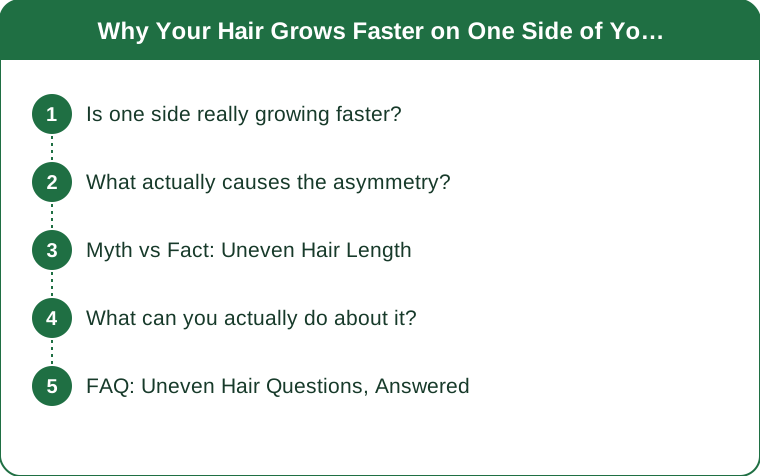
Is one side really growing faster?
Almost never at the follicle. The difference is nearly always in what happens to the hair after it grows.
Growth rate is broadly consistent across the scalp — hair grows on average around a centimetre a month, with individual variation, and the rate at one follicle is not meaningfully different from a follicle a few centimetres away on the other side of a midline.
Length is growth minus loss. A hair that grows normally but breaks at 30cm will never reach 40cm. If one side experiences more mechanical stress, that side reads as shorter even though every follicle is doing identical work.
Facial and skull asymmetry is normal and universal. Nearly everyone has some asymmetry in the skull, jaw and the position of the ears, and hair falling over a slightly different surface hangs differently. Some of what looks like a length difference is a drape difference.
Your part contributes. A side part means more hair falls to one side, which changes both the visible length and the mechanical stress. Move the part and the perceived difference often changes with it.
Density can genuinely differ slightly between sides, and a denser side can appear to hang longer or fuller. This is a real but usually small effect.
And how you check matters. Pull both sides forward under the chin and compare — most people assess in a mirror, where the two sides are at different distances from the reflective surface and your head is rarely perfectly level.
What actually causes the asymmetry?
Five habits, and most people have at least three of them.
Sleep position is the biggest one. If you sleep predominantly on one side, that side spends six to eight hours a night compressed against a pillow with friction on every movement. Over years, that is a very large amount of mechanical stress applied to one side only. This is the most common single cause.
Your dominant hand. You brush from one side more forcefully, you tuck hair behind one ear reflexively, you twist and play with one side while thinking, and you style with more force on the side your dominant hand reaches easily. Each is trivial; together they are thousands of repetitions a year.
Bag straps and seatbelts. A shoulder bag carried on the same side every day, or a crossbody strap, produces continuous friction at exactly one point on one side. This is a genuinely common and completely invisible cause.
Sun exposure while driving. If you drive regularly, one side of your head gets substantially more UV through the side window than the other. UV degrades the hair shaft and the effect over years is real, particularly for lighter or chemically treated hair.
Heat styling technique. Most people apply heat more carefully and more slowly to the side they can see and reach best, and rush the other. Whichever side gets the rushed, hotter, repeated passes is the side that breaks.
One more that catches people out: if you have a cowlick, a growth pattern whorl, or hair that naturally falls in one direction, it may lie in a way that means one side has more friction against clothing and shoulders.

Myth vs Fact: Uneven Hair Length
Myth: One side grows faster because of blood flow differences. Fact: There is no meaningful evidence that scalp blood flow differs enough between sides to change growth rate. The mechanism people reach for does not hold up, and breakage explains the observation far better.
Myth: Trimming the longer side will make them even permanently. Fact: It makes them even today. If the underlying cause is breakage on one side, they will diverge again. Trimming addresses the symptom, which is fine as long as you know that is what you are doing.
Myth: It means something is wrong with your health. Fact: Mild asymmetry is extremely common and is not a health signal. Sudden, marked, one-sided hair loss — as opposed to length difference — is different and does warrant a medical look.
Myth: Sleeping on a silk pillowcase will fix it. Fact: It reduces friction, which genuinely helps breakage, and it will not correct an existing difference. It is preventive, and it does not address bag straps, heat styling or sun.
Myth: Hair grows faster in summer, so a summer of sun caused it. Fact: There is some evidence for modest seasonal variation in growth and shedding, but it applies to the whole head rather than one side. Sun through a car window, on the other hand, is genuinely one-sided.
Myth: You can retrain the growth by brushing the short side more. Fact: More brushing means more mechanical stress, which is the opposite of what a breakage-prone side needs. Handle the shorter side more gently, not more.
What can you actually do about it?
Reduce stress on the shorter side, even out the habits, and be patient — this is a slow-moving problem in both directions.
Alternate your sleep side deliberately if you can. This is the highest-value change and the hardest to implement. A silk or satin pillowcase is the practical alternative, and it genuinely reduces friction for anyone who cannot change position.
Switch your bag shoulder. Free, immediate, and it removes an ongoing friction source most people have never connected to their hair.
Tie your hair differently. If you always tie it at the same spot, or always tuck the same side, move it. Varying the anchor point of a ponytail is generally good practice for breakage and it is specifically relevant here.
Handle the shorter side more gently. Brush it with a soft brush, detangle from the ends upward, and reduce heat exposure. If you must rush one side while styling, rush the longer one.
Use UV protection if you drive a lot. A hair product with UV filters, or simply a hat for long drives, addresses a cause that nothing else touches.
Get a trim shaped by someone who knows. A stylist can cut to disguise asymmetry rather than simply levelling it, which looks better than a blunt correction and does not sacrifice as much length.
Give it months, not weeks. At around a centimetre a month, a 3cm difference takes three months to close even in perfect conditions, and only if the breakage has genuinely stopped.
Watch for the autumn shedding overlap. Seasonal shedding is commonly reported in late summer and autumn, and increased shedding across the whole head can make an existing asymmetry look suddenly worse. That is a temporary overlay on a longer-term pattern, and it usually settles within a couple of months.
When is it worth seeing a doctor?
If one side is losing hair rather than length — visible thinning, a widening part on one side only, patches, scalp changes, itching or pain — that is a different problem from asymmetric breakage and is worth a dermatologist’s assessment. The same applies to sudden dramatic shedding. This is general information, not medical advice.
FAQ: Uneven Hair Questions, Answered
How common is this?
Very. Some degree of length asymmetry is close to universal once hair is long enough for it to show, and most people simply never look closely.
How big a difference is normal?
A couple of centimetres is entirely unremarkable. A difference large enough to be obvious in every photograph is worth investigating for a habit cause, and a difference in density rather than length is worth a medical look.
Can a haircut fix it?
It can even it up today, and it will return if the cause continues. Fixing the habit and then trimming is the durable order.
Does hair grow faster when it is shorter?
No — that is a persistent myth. Shorter hair has had less time to accumulate damage, so it looks healthier, but the growth rate at the follicle is unchanged.
Which side is usually shorter?
Commonly the side you sleep on and the side your dominant hand reaches most. For most right-handed people who sleep on their right, that means the right. It is not universal.
Will it ever be perfectly even?
Probably not, and it does not need to be. Skull asymmetry, density variation and drape mean perfectly even is not a realistic or necessary target.
TL;DR:
- Hair does not grow at meaningfully different rates side to side. Length = growth minus breakage, and breakage is asymmetric.
- The usual causes are sleep position, your dominant hand, bag straps, driving sun exposure and rushed heat styling.
- Trimming evens it today; it returns unless the habit changes. Fix the cause, then trim.
- Switch your bag shoulder, vary your ponytail position, and handle the shorter side more gently — not more.
- At about a centimetre a month, closing a visible gap takes months.
Thinning or a widening part on one side is a different problem from uneven length, and that one is worth a doctor’s look.
Keep Reading
This article is for general informational purposes only and is not medical advice. Always consult a qualified health professional for guidance specific to you.