Why the Hair at Your Temples Grows Back Finer Than Everywhere Else
Quick Answer: Temple follicles are naturally smaller and produce finer hair than follicles on the crown, they are more sensitive to hormonal signals, and they sit exactly where glasses, headbands, ponytails, and sleeping friction all concentrate. So temple regrowth is genuinely finer, genuinely slower, and genuinely more fragile than regrowth elsewhere - and the biggest wins there come from removing tension rather than adding product.
The rest of your hair recovered. The temples are still a soft, wispy fringe that will not catch up.
There are three separate reasons for that and only one of them is under your control - but it happens to be the one that matters most.


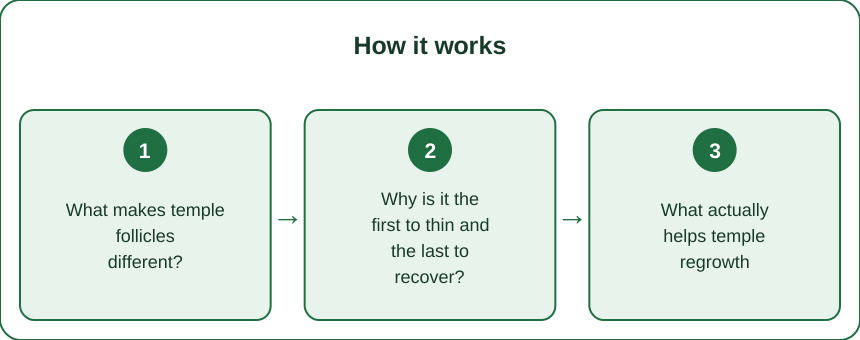
What makes temple follicles different?
They are smaller by design. The follicles along the hairline and temples naturally produce finer, shorter hairs than those on the mid-scalp. This is normal anatomy - the fringe of fine hair is meant to be there.
Their growth cycle is shorter. A shorter anagen phase means the hair does not reach the length that mid-scalp hair does before shedding, so temple hair looks perpetually behind even when the follicle is perfectly healthy.
They are more androgen-sensitive. The hairline and temples are among the most hormonally responsive areas of the female scalp, which is why hormonal changes show up there before anywhere else.
Blood supply at the margins is less generous than at the mid-scalp, which contributes to slower recovery from any insult - chemical, mechanical, or nutritional.
The skin itself is thinner at the temples, making the area more reactive to product, heat, and friction than the crown is.
And density there is lower to begin with, so any given amount of loss is more visible. A ten percent thinning at the temple is obvious; the same at the back of the head is invisible.
Why is it the first to thin and the last to recover?
Mechanical tension concentrates there. Ponytails, buns, braids, headbands, and glasses arms all pull on or rub the same narrow band. Repeated tension is the single most established cause of hairline thinning in women.
The damage is cumulative and slow. Traction thinning develops over months and years, which is why it rarely connects in people’s minds to the hairstyle they have worn since school.
Sleeping friction hits the temple you sleep on, and most people sleep predominantly on one side. Asymmetric temple thinning is common and usually mechanical rather than medical.
Chemical processing reaches the hairline first - dye, relaxer, and bleach are applied at the roots and the temples get the longest contact time in most application patterns.
Heat styling concentrates there too, because the face-framing pieces are the ones people style most and the ones closest to the skin.
And recovery is slow because the follicle has to complete a full cycle to show progress. With a shorter anagen phase and finer output, visible improvement at the temples takes three to six months even when everything is going right - which is longer than most people give it before concluding nothing is working.

What actually helps temple regrowth
Remove the tension first. This is the highest-return action by a wide margin, and it is free. Loosen ponytails, vary the style daily, avoid the same parting for months, and stop using tight elastics near the hairline.
Check whether it hurts. A hairstyle that causes any scalp tenderness is applying enough tension to matter. Pain is a threshold signal, not a tolerance test.
Change which side you sleep on, or use silk. A satin or silk pillowcase reduces friction meaningfully, and it is the easiest intervention to sustain because it requires nothing of you daily.
Be patient with scalp treatments and give them a full cycle. Whatever you use - topical treatments, scalp massage, or a serum - three to six months is the minimum honest evaluation window at the temples specifically.
Protect the hairline during colouring. Ask for a barrier cream at the temples, or accept slightly more visible regrowth there in exchange for less chemical exposure on the most fragile follicles you have.
Address the underlying cause if the thinning is recent and rapid. Sudden hairline change alongside other symptoms deserves a professional conversation, particularly around thyroid function, iron status, and hormonal changes.
And style the fringe rather than fighting it. Face-framing pieces, a slightly softer parting, and avoiding severe pulled-back styles both reduce the tension and make the existing hair look considerably better while it recovers. This is general information, not medical advice - persistent or rapid hair loss deserves a clinician’s assessment.
Myth vs Fact: Temple Hair
Myth: Fine hair at the temples means the follicles are dying. Fact: temple follicles produce finer hair by design, with a shorter growth cycle. A soft fringe there is normal anatomy, not necessarily loss.
Myth: Regrowth that stays short means it stopped growing. Fact: temple hair has a shorter anagen phase, so it reaches a shorter maximum length than mid-scalp hair and then sheds. It is completing its cycle, not failing.
Myth: Tight styles only cause damage if they hurt. Fact: pain marks a clear threshold but tension below the pain threshold still accumulates over months. Chronic mild tension is the common pattern, not the dramatic one.
Myth: Asymmetric temple thinning means something is medically wrong. Fact: it is usually mechanical - the side you sleep on, the side your bag strap sits on, or the direction you habitually push your hair. Worth noticing, rarely worth alarm.
Myth: Oils and serums regrow temple hair fastest. Fact: removing tension outperforms every topical for traction-related thinning, and it is free. Topicals help; they cannot outrun a daily tight ponytail.
Myth: Three months of no visible change means it is not working. Fact: three to six months is the minimum evaluation window at the temples because of the shorter cycle and finer output. Judging at six weeks is judging too early.
FAQ: Temple Regrowth, Answered
Why is my temple hair finer than the rest?
Temple follicles are naturally smaller with a shorter growth phase, so they produce finer and shorter hair even when completely healthy. Lower baseline density there makes any change more visible.
Why is one temple thinner than the other?
Usually mechanical - the side you sleep on, the side a bag strap sits, or a habitual parting. Asymmetry is far more often friction than pathology.
How long until I see regrowth at the temples?
Three to six months minimum, because the follicle has to complete a full cycle and that cycle is shorter and finer there. Six weeks is far too early to judge.
What is the single most effective change?
Removing tension. Looser styles, varied partings, no tight elastics near the hairline, and a silk pillowcase outperform any topical for traction-related thinning.
Does a tight ponytail really cause permanent loss?
It can if sustained for years - prolonged traction can eventually scar the follicle. Caught early, the thinning is generally reversible.
When should I see a professional?
If the thinning is rapid, patchy, accompanied by scalp symptoms, or paired with fatigue or cycle changes. Sudden hairline change deserves a proper assessment rather than another serum.
TL;DR:
- Temple follicles are naturally smaller with a shorter growth cycle, so regrowth there is genuinely finer and slower.
- They are also the most androgen-sensitive area of the scalp and the one taking the most mechanical stress.
- Removing tension - looser styles, varied partings, no tight elastics at the hairline - beats every topical for traction thinning.
- A silk pillowcase and changing your sleeping side address the most common cause of asymmetric thinning.
- Give any treatment three to six months before judging, because the temple cycle is shorter and the output finer.
Rapid or patchy loss is a clinician’s question, not a product question.
Keep Reading
This article is for general informational purposes only and is not medical advice. Always consult a qualified health professional for guidance specific to you.